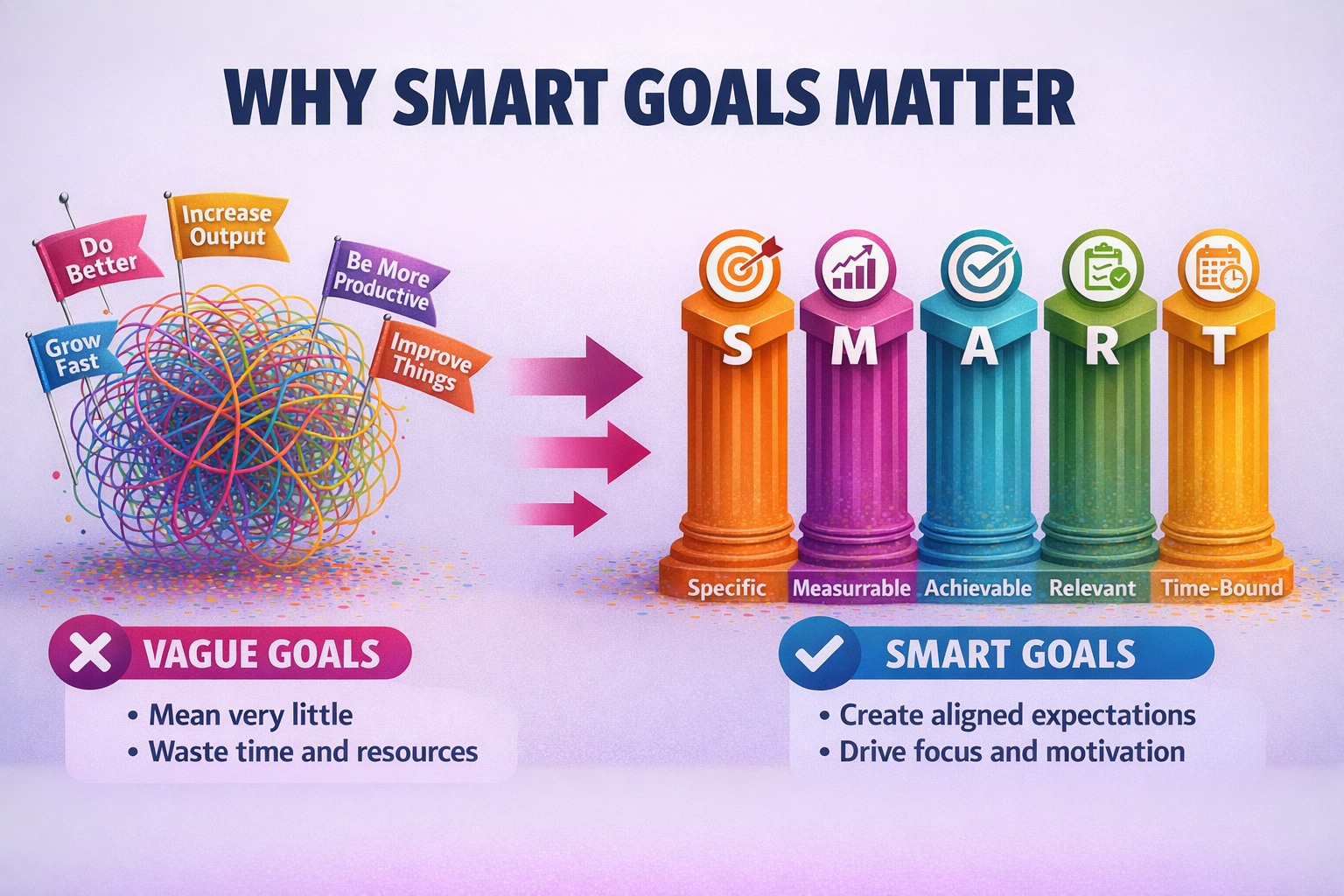
Why SMART Goals are still important.
We’ve all heard the advice: set goals.
What gets measured gets delivered
But in reality, many goals are too vague to create action or allow measurement.
I’ve seen many individual goals which have been agreed with their manager, which measurable and can cause more harm than good. A well definded goal should be easily understood and clear regarding what success looks like. Goals should be motivating to the team member who feels that they are clear on what they are deivering and how they are contibuting to the team and greater business.
Goals such as those below, may seem fine when drafted but when it’s time to discuss performance they are pretty meaningless.
To be honest it may be adventagous to not have goals rather than vague goals.
“I want to improve performance.”
“I want to be a better leader.”
“I want the team to communicate more.”
They may sound positive, but they’re not clear enough to guide behavior, measure progress, or create accountability.
Goals aren’t always easy to formulate and do need to have thought put into them to make them meaningful.
That’s where SMART goals come in.
Goals should also be ‘live’ they adapt and update as required.
What Are SMART Goals?
SMART goals are goals that are:
* Specific * Measurable * Achievable * Relevant * Time-bound
They turn good intentions into clear, actionable plans.
Rather than setting a broad goal like improve employee engagement, a SMART goal would sound more like:
Increase employee engagement survey participation from 68% to 85% by the end of Q3 by improving communication, simplifying the survey process, and reminding managers to encourage completion.
Now there is clarity. People know what success looks like, how it will be measured, and by when.
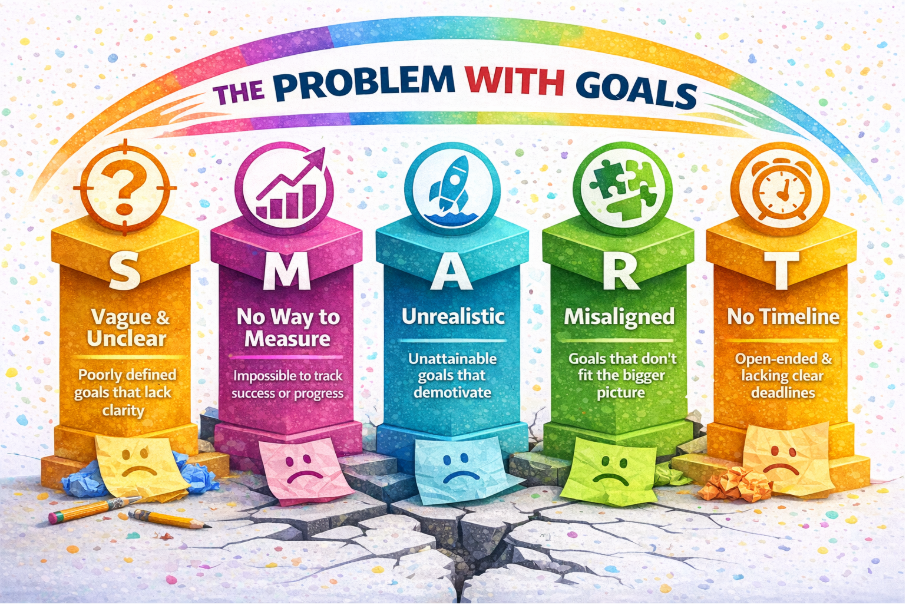
Why SMART Goals Work
One of the biggest reasons people and teams struggle with performance is not a lack of effort.
It’s a lack of clarity.
When expectations are unclear, people can feel like they are working hard but still missing the mark. Leaders can become frustrated that progress isn’t happening, while team members feel confused about what they’re actually aiming for.
SMART goals help solve that by creating:
Focus – everyone knows the priority
Clarity – expectations are easier to understand
Accountability – progress can be tracked
Momentum – smaller actions feel more manageable
Confidence – success becomes more visible and achievable
They shift goals from being aspirational to practical.
Breaking Down SMART Goals
Specific
A specific goal is clear and well-defined.
Instead of: Improve team communication
Try: Introduce a weekly 30-minute team check-in to improve cross-functional communication and alignment
The clearer the goal, the easier it is to act on.
Measurable
If you can’t measure it, it’s difficult to know whether progress is being made.
Ask yourself:
What does success look like?
How will I know if this is working?
What evidence will show progress?
For example:
Reduce average time-to-hire from 45 days to 30 days
That gives you something concrete to track.
Achievable
A good goal should stretch people, but still be realistic.
If a goal feels impossible, it can create pressure without progress.
If it’s too easy, it won’t drive meaningful growth.
The key is to balance ambition with what is genuinely possible given the time, resources, and support available.
Relevant
A goal should matter.
It should connect to the broarder priorities of the business, team, or individual. If a goal looks good on paper but doesn’t support what actually matters right now, it can become a distraction rather than a driver.
A relevant goal answers the question:
Why does this matter?
Time-Bound
Deadlines create commitment.
Without a timeframe, goals often drift. There’s always another priority, another meeting, another reason to delay.
A time-bound goal creates urgency and helps people plan the steps needed to get there.
For example: Complete manager training for all new people leaders within 60 days of promotion
Now there is a clear endpoint.
Common Mistakes When Setting SMART Goals
Even with the SMART framework, goals can still miss the mark, goals can be hard to nail down (AI can help!)
Some of the most common issues include:
Setting goals that are too broad
Choosing measures that don’t really reflect success
Creating unrealistic timelines
Setting goals that are disconnected from business priorities
Writing goals that sound impressive but don’t guide day-to-day action
A SMART goal should be simple enough for someone to understand quickly and practical enough to drive decisions.
SMART Goals in the Workplace
SMART goals are especially useful in performance management, leadership development, and growing businesses where people need clarity.
They can help with:
Setting team priorities
Improving individual performance
Supporting employee development
Clarifying expectations for new managers
Driving accountability in fast-growing teams
Turning strategy into action
For founders and leaders, SMART goals can also reduce the frustration that comes when expectations live only in someone’s head.
If you want people to succeed, they need more than a vague ambition — they need a clear target.
A Simple Example
Here’s the difference between a vague goal and a SMART goal:
Vague goal: Improve onboarding
SMART goal: Reduce new hire ramp-up time by implementing a structured 30-day onboarding plan for all new employees by June 30, with manager check-ins at week 1, week 2, and week 4.
The second version creates direction, ownership, and measurable success.
Final Thought
SMART goals are not about making work rigid or overcomplicated. They are about creating clarity.
When goals are clear, people know what’s expected.
When progress is measurable, success is easier to see.
When timelines are defined, action becomes more likely.
They should be ‘live’, updated when necessary.
Whether you’re leading a team, building a business, or developing your own career, SMART goals can help turn intention into impact.
If progress has stalled, the issue may not be motivation.
It may simply be that the goal was never clear enough to begin with.